


Quick Answer
A bellows sealed globe valve uses a welded metal bellows as its primary stem seal, replacing the compression packing found in standard valves. This design eliminates the wear mechanism that causes leaks over time, providing certified zero-leakage performance for toxic, flammable, or high-value media. While it has a higher initial cost, it requires less maintenance and offers a longer service life.
Standard globe valves leak from the stem. Not immediately. Over time. The packing that seals the stem wears down with each operation. Eventually it leaks. A bellows sealed globe valve removes that failure mode entirely. Metal bellows welded to the stem and valve body. No packing as the primary seal. The stem moves inside a sealed metal enclosure that flexes with it. No wear mechanism on the primary seal during normal operation.
What Is a Bellows Seal?
A bellows seal is a thin-walled corrugated metal tube. One end welded to the valve stem. Other end welded to the bonnet. The corrugations flex as the stem moves up and down. Process fluid stays inside. Outside environment stays out. No compression fitting. No packing material to wear down. Just a welded metal barrier that moves with the stem.
Bellows material is typically austenitic stainless steel, Inconel, or compatible alloys. Bellows material selection follows the same logic as body and trim selection. 316 stainless bellows in chloride service faces the same pitting risk as a 316 stainless body in the same service. Material compatibility matters as much for the bellows as it does for any other wetted component.
Most designs include a secondary packing seal above the bellows. Backup only. If the bellows fails, the packing prevents immediate external leakage. Gives the plant time to shut down safely instead of facing an uncontrolled release.
How It Achieves Zero-Leakage Sealing
Standard globe valve packing compresses against the stem surface. That compression seals the gap between the stem and the bonnet bore. Stem moves. Packing cycles. Packing wears. Compression drops. Seal degrades. Eventually needs retightening or repacking. That cycle never stops.
Bellows sealed globe valve zero leakage performance works on a different principle. The bellows is welded. Not compressed. Does not resist stem movement. Flexes around it. No friction. No wear mechanism acting on the primary seal during normal cycling. The seal does not degrade the same way packing does.
Fugitive emission performance of bellows sealed designs is tested to ISO 15848-1 and API 622. These standards define maximum allowable stem leakage rates in parts per million for valves in fugitive emission-regulated service. CTGV’s bellows sealed globe valves are certified to both. That certification is the documentation requirement for regulated chemical, petrochemical, and refinery service.
Applications: Toxic, Flammable, and High-Value Media
Bellows sealed globe valve designs go into service where any stem leakage creates a safety, environmental, or economic problem.
Toxic chemical service. Hydrogen sulfide, chlorine, phosgene. These fluids cannot leak from the stem. A standard packed globe valve in this service needs regular packing inspection and adjustment. Every inspection is a maintenance exposure event. Bellows sealed globe valve zero leakage design removes that requirement and the associated risk to maintenance personnel.
Flammable hydrocarbon service. Refineries and petrochemical plants. Stem leakage of volatile hydrocarbons creates fire and explosion risk. Most jurisdictions require fugitive emission-certified valves on equipment handling volatile organic compounds above certain thresholds. The bellows sealed design meets those requirements as a standard feature.
High-value media. Pharmaceutical intermediates, specialty chemicals, rare gases. Leakage here is direct product loss. Not just a maintenance issue. Every drop that escapes the stem has a cost attached to it.
Nuclear service. Radioactive fluid systems. Any external leakage is a regulatory and safety event. Bellows provides primary containment. Backup packing provides secondary containment. Both required by nuclear safety standards.

Materials: WCB, WC1, WC6, WC9, CF8, CF3, CF8M, CF3M
What is the main difference between a bellows sealed globe valve and a standard packed globe valve?
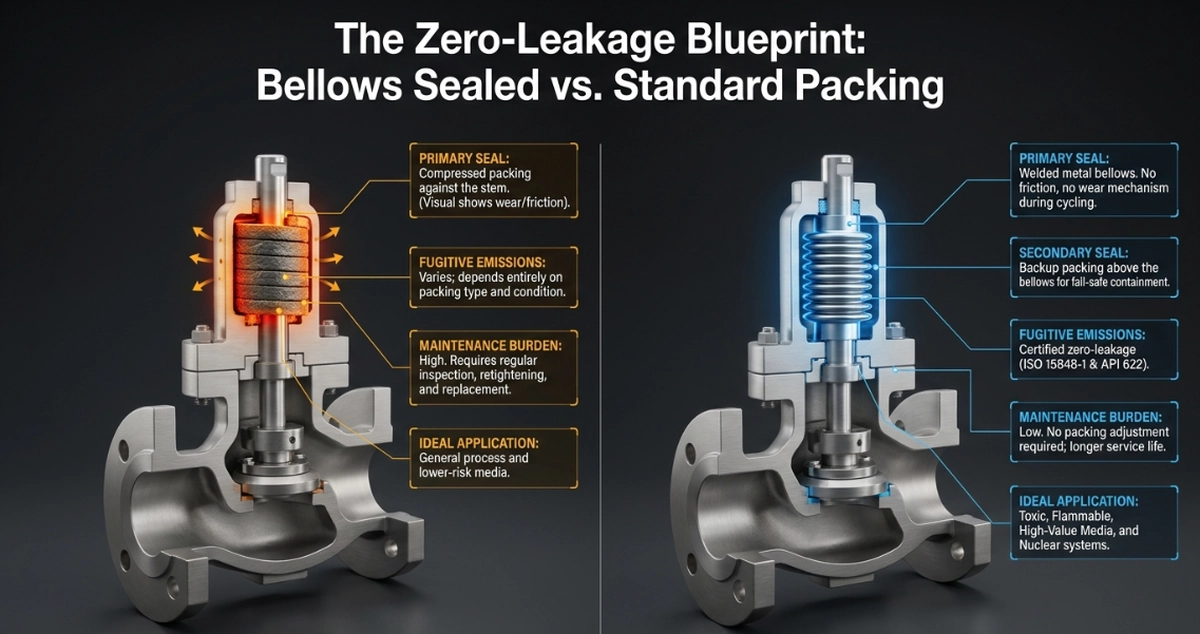
The primary seal mechanism. Standard packed globe valve uses compressed packing against the stem. Bellows sealed globe valve uses a welded metal bellows. Packing wears every time the valve operates. Bellows flexes without a wear mechanism. Lower long-term leakage rates. Lower maintenance frequency. Higher initial cost. That is the tradeoff.
Bellows Sealed vs Standard Packing Globe Valves
The table below compares both designs across the factors that drive selection in process industry applications.
| Factor | Bellows Sealed Globe Valve | Standard Packing Globe Valve |
| Primary seal | Welded metal bellows | Compressed packing against stem |
| Fugitive emissions | ISO 15848-1, API 622 certified | Depends on packing type and condition |
| Maintenance | Low, no packing adjustment needed | Regular inspection and retightening |
| Service life | Longer between interventions | Packing replacement cycles required |
| Cost | Higher initial cost | Lower initial cost |
| Best for | Toxic, flammable, high-value, nuclear | General process, lower risk media |
| Backup seal | Secondary packing above bellows | Packing is the only seal |
Standard packing suits general process service where leakage is an inconvenience and maintenance is routine. Bellows sealed suits service where leakage is a safety event, an environmental violation, or a significant economic loss. Different tools. Different service conditions. Not interchangeable.
CTGV manufactures bellows sealed globe valves from 1/2 inch to 14 inch across Class 150 to 900LB. Body materials cover WCB, WC6, WC9, CF8, CF3, CF8M, and CF3M. Certified to ISO 15848-1, API 622, NACE MR 0103, and NACE MR 0175 for sour service. End connections include RF, RTJ, BW, SW, and NPT. Get in touch and receive a recommendation within 2 hours.
Frequently Asked Questions
What is a bellows sealed globe valve?
A globe valve where a welded metal bellows replaces stem packing as the primary external seal. Bellows flexes around stem movement without wearing. Provides near-zero fugitive emissions during normal operation. Backup packing above the bellows provides secondary containment if the bellows fails in service.
Why use a bellows seal instead of packing?
Packing wears with each valve operation and eventually leaks. Bellows has no wear mechanism during normal cycling. For toxic, flammable, or high-value media where stem leakage is a safety or environmental problem, bellows removes the primary failure mode of the standard packing seal design.
What standards apply to bellows sealed globe valves?
ISO 15848-1 and API 622 for fugitive emission performance. NACE MR 0103 and MR 0175 for sour service. API 598 for pressure testing. Nuclear service applications require additional standards beyond standard process valve certification requirements.
How long does a bellows seal last?
Depends on cycle count, operating temperature, and fluid compatibility. Most manufacturers rate bellows for 10,000 to 50,000 operating cycles depending on design and material. Backup packing provides secondary sealing if the bellows reaches end of design life during service.


